


Speed Bleeders for brakes
#1
 01-10-2007


Speed Bleeders for brakes
I usually work on my truck alone but there are some jobs that are difficult for one person. One is bleeding brakes. The traditional tool for the lone home mechanic has been the MityVac hand vacuum pump with the bleeder attachment.
I recently tried Speed Bleeders and they are an interesting alternative.
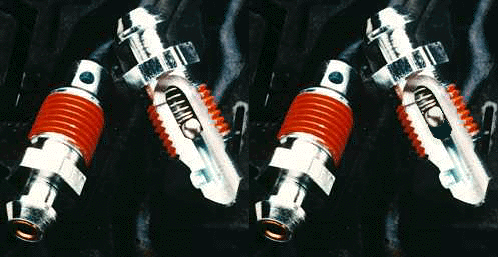
A Speed Bleeder looks very much like an ordinary brake bleeder fitting but it has three important differences: an internal one-way check valve, a side port and thread sealant on the outside of the bleeder threads.
These three changes prevent air from being sucked back into the caliper or slave cylinder when the brake pedal is released during bleeding. The result is that one person can pump the brakes and purge all of the air after several repetitions. Pretty slick, IMO.
The bleeding procedure is dead simple:
So, what's the downside? Well, the strange thing is that you can't tell when you're finished.
When bleeding the traditional way with a helper, it is obvious when the bubbles stop appearing. With the Speed Bleeder, you can feel the pedal resistance increase as more and more air leaves the brake system. The question then becomes, "How many repetitions is enough to do the job?". In an effort to be sure that the air was completely purged, I ended up cycling the pedal 20 times. Would 15 have been enough? How about 10? The only safe answer is to go into overkill mode and that wastes some brake fluid.
That is the only thing about the Speed Bleeder concept that I could fault.
If you bleed the brakes a lot, you will eventually wear the coating from the threads and the bleeders will no longer work properly because of air leakage. Speed Bleeder claims that this is a problem only in applications like race car brakes which tend to be bled very often. The company offers replacement sealant for users who find themselves in that situation.
Speed Bleeders appear to be well made and come with rubber dust caps. They are manufactured in a variety of lengths, diameters and thread pitches, both fractional and metric. Charts are provided at the Speed Bleeder website for automotive and motorcycle applications.
Each standard plated bleeder costs $7. Stainless steel is offered for appearance applications like show cars, motorcycles, etc. The SS bleeders are $15 each.
http://www.speedbleeder.com/
Speed Bleeder Products, Inc
13140 Apakesha Rd.
Newark, IL 60541
888 879 7016
Speed Bleeders are also available from Summit, Russell, JEGS and many other distributors. The prices are sometimes a little better, too.
I recently tried Speed Bleeders and they are an interesting alternative.
A Speed Bleeder looks very much like an ordinary brake bleeder fitting but it has three important differences: an internal one-way check valve, a side port and thread sealant on the outside of the bleeder threads.
These three changes prevent air from being sucked back into the caliper or slave cylinder when the brake pedal is released during bleeding. The result is that one person can pump the brakes and purge all of the air after several repetitions. Pretty slick, IMO.
The bleeding procedure is dead simple:
- Attach a hose to the bleeder and stick it in a container to catch the extra fluid expelled.
- Open the bleeder about 1/4 turn.
- Cycle the brake pedal slowly. You want to depress it as far as possible.
- Repeat until all of the air is expelled.
- Close the bleeder valve.
So, what's the downside? Well, the strange thing is that you can't tell when you're finished.
When bleeding the traditional way with a helper, it is obvious when the bubbles stop appearing. With the Speed Bleeder, you can feel the pedal resistance increase as more and more air leaves the brake system. The question then becomes, "How many repetitions is enough to do the job?". In an effort to be sure that the air was completely purged, I ended up cycling the pedal 20 times. Would 15 have been enough? How about 10? The only safe answer is to go into overkill mode and that wastes some brake fluid.
That is the only thing about the Speed Bleeder concept that I could fault.
If you bleed the brakes a lot, you will eventually wear the coating from the threads and the bleeders will no longer work properly because of air leakage. Speed Bleeder claims that this is a problem only in applications like race car brakes which tend to be bled very often. The company offers replacement sealant for users who find themselves in that situation.
Speed Bleeders appear to be well made and come with rubber dust caps. They are manufactured in a variety of lengths, diameters and thread pitches, both fractional and metric. Charts are provided at the Speed Bleeder website for automotive and motorcycle applications.
Each standard plated bleeder costs $7. Stainless steel is offered for appearance applications like show cars, motorcycles, etc. The SS bleeders are $15 each.
http://www.speedbleeder.com/
Speed Bleeder Products, Inc
13140 Apakesha Rd.
Newark, IL 60541
888 879 7016
Speed Bleeders are also available from Summit, Russell, JEGS and many other distributors. The prices are sometimes a little better, too.

#4
01-10-2007
Join Date: Apr 2006
Location: Lake Elsinore, Ca.
Posts: 643
Likes: 0
Received 0 Likes
on
0 Posts
#5
01-10-2007
Originally Posted by doc
For the sake of sounding stupid... When would you need to bleed the brakes? I change my pads but have never bled my lines before.
Also, when your brake pressure isn't too great, bleeding the brakes should help that... so I understand.
#6
01-10-2007
Originally Posted by doc
For the sake of sounding stupid... When would you need to bleed the brakes? I change my pads but have never bled my lines before.


#8
01-10-2007


Thread
Thread Starter
Forum
Replies
Last Post
patkelly1336
Drivetrain Tech
7
10-06-2012 08:04 PM


