


Sticky/slow brake pedal


Thread Starter
|
Member
Joined: Nov 2018
Posts: 7
Likes: 0
From: San Jose, CA

Sticky/slow brake pedal
Hello. First post and new owner of a 1990 Ranger. I know nothing John Snow. I mean, I know nothing about cars or trucks, but I wanted to learn and maintain my own. I have some knowledge of motorcycles so some things are familiar. I bought this ranger and found that it has a sticky brake pedal. When I hit the brakes and let go, it will continue to engage the brakes and is slow to release. How would I troubleshoot what is going on here? I've been told to check the master cylinder to make sure there's enough brake fluid. I think it has enough. But then, I'm not sure if I was looking at the master cylinder. I was looking at the reservoir behind the steering column under the hood.


Welcome to the forum
Under the hood on drivers side, on the firewall(metal "wall" that separates engine area from cab area) you will see the power brake Booster
Picture here: https://cimg1.ibsrv.net/gimg/www.for...92c924bf30.jpg
No, not a Ranger, lol, the large black drum is the Power Booster
The part attached to it is the Brake Master cylinder, with the two hoses(brake lines)
On top of that is the Brake fluid reservoir, the white plastic part, that is what you "top up" if brake fluid is low
Your problem could be a few things
Start the engine up
Don't touch the brake pedal after start up
Count to 10 and turn engine off, count to 10 again
Now press down on brake pedal, 3 times
You should have "power assist" 2 of those 3 times then pedal will get hard to press down
If pedal is hard to press down the 1st time then Power booster is bad, leaking vacuum, and that is causing the booster to hold brake pedal down after you press it with engine running
If power booster seems OK then Master would be next guess but no real way to test that unit, just need to replace it
One question, can you lift up brake pedal with your foot after pressing it down, and does that release the brakes?
Block a tire so no roll a ways
Start engine
Use your hand to press down brake pedal and pull it back up, up at the top of the pedal arm is a pivot point and bushing, if this bushing wears out pedal can get loose and turn sideways in the pivot hole, this can cause what you describe, the pedal itself has the resistance so master/booster can not push it back up
Under the hood on drivers side, on the firewall(metal "wall" that separates engine area from cab area) you will see the power brake Booster
Picture here: https://cimg1.ibsrv.net/gimg/www.for...92c924bf30.jpg
No, not a Ranger, lol, the large black drum is the Power Booster
The part attached to it is the Brake Master cylinder, with the two hoses(brake lines)
On top of that is the Brake fluid reservoir, the white plastic part, that is what you "top up" if brake fluid is low
Your problem could be a few things
Start the engine up
Don't touch the brake pedal after start up
Count to 10 and turn engine off, count to 10 again
Now press down on brake pedal, 3 times
You should have "power assist" 2 of those 3 times then pedal will get hard to press down
If pedal is hard to press down the 1st time then Power booster is bad, leaking vacuum, and that is causing the booster to hold brake pedal down after you press it with engine running
If power booster seems OK then Master would be next guess but no real way to test that unit, just need to replace it
One question, can you lift up brake pedal with your foot after pressing it down, and does that release the brakes?
Block a tire so no roll a ways
Start engine
Use your hand to press down brake pedal and pull it back up, up at the top of the pedal arm is a pivot point and bushing, if this bushing wears out pedal can get loose and turn sideways in the pivot hole, this can cause what you describe, the pedal itself has the resistance so master/booster can not push it back up
Thread Starter
|
Member
Joined: Nov 2018
Posts: 7
Likes: 0
From: San Jose, CA
Thanks man. I tried the test and the brake pedal feels stiff on all 3 presses, but no noticeable difference between the 3. I think it might be low on brake fluid. I looked inside the master cylinder reservoir and its about half way from the max line. Is there a specific brake fluid I should be using? I don't know which brand is in there but its a blue/aqua-ish color. Is it bad to mix different brands? Like, is there a chance it could coagulate?
EDIT:
Nevermind, found the answer. You can mix different brands and DOT fluids but not DOT5. DOT5 is used in racing and the military primarily.
EDIT:
Nevermind, found the answer. You can mix different brands and DOT fluids but not DOT5. DOT5 is used in racing and the military primarily.
Last edited by Rranger; Nov 22, 2018 at 10:11 AM. Reason: Answer found
Any Brand of DOT 3 Brake Fluid, that was standard fluid in Rangers
DOT 3 is a Heat Rating, DOT stands for Department of Transportation, so DOT 3 means its a US standard heat rating of 3
DOT 3 and 4 fluids can be mixed, no worries there
DOT 5 can NOT be mixed with anything else, so "they" now have DOT 5.1, it can be mixed with DOT 3 and 4 but not DOT 5
The higher the number the higher the heat it can stand, most passenger vehicles use DOT3
But thats not your problem, low fluid will cause no brakes, pedal goes down to the floor because AIR gets in the system, but top it up in any case.
The reservoir on top of the Master Cylinder is just that, a Reservoir, it's the fluid the master is NOT USING at the moment, but MAY need if there is a leak in the system
Because fluid level is low in the reservoir, it would be a good idea to check for leaks at all 4 wheels and also look for wet spots on the ground under the vehicle after its been parked a dew hours.
You will need to check the Power Booster and its hose
On the booster there is a Check valve with a rubber hose attached to it
That rubber hose runs over to the upper engine, it is a Vacuum hose
When a gasoline engine is running the Intake Manifold will have Vacuum, really just lower air pressure but "we" call it Vacuum, like a vacuum cleaner sucks in air, thats the vacuum in this description
The Power Booster uses this Vacuum to assist driver pushing down the brake pedal.
So when engine is running the brake pedal should be easy to push down
For safety reasons there is a Check valve on the booster, this valve HOLDS some vacuum in the booster as a reserve in case the engine should stall while driving, i.e. vacuum is gone so no Power Brakes
There is usually enough Vacuum held in reserve for 2 or 3 pedal pushes to get vehicle safely stopped
You don't have that
So either check valve is bad or booster has a leak
It also possible for Vacuum hose to have a leak, but you would also have a very high idle if that was the case and you don't mention that.
Check valves don't often fail, not much to fail inside these, so most like issue is the Power booster has failed
Remove Vacuum hose from engine end
Suck on the hose, apply Vacuum to the hose
It should hold Vacuum, you should not Hear air escaping
You can buy a vacuum hand pump and gauge for this test
DOT 3 is a Heat Rating, DOT stands for Department of Transportation, so DOT 3 means its a US standard heat rating of 3
DOT 3 and 4 fluids can be mixed, no worries there
DOT 5 can NOT be mixed with anything else, so "they" now have DOT 5.1, it can be mixed with DOT 3 and 4 but not DOT 5
The higher the number the higher the heat it can stand, most passenger vehicles use DOT3
But thats not your problem, low fluid will cause no brakes, pedal goes down to the floor because AIR gets in the system, but top it up in any case.
The reservoir on top of the Master Cylinder is just that, a Reservoir, it's the fluid the master is NOT USING at the moment, but MAY need if there is a leak in the system
Because fluid level is low in the reservoir, it would be a good idea to check for leaks at all 4 wheels and also look for wet spots on the ground under the vehicle after its been parked a dew hours.
You will need to check the Power Booster and its hose
On the booster there is a Check valve with a rubber hose attached to it
That rubber hose runs over to the upper engine, it is a Vacuum hose
When a gasoline engine is running the Intake Manifold will have Vacuum, really just lower air pressure but "we" call it Vacuum, like a vacuum cleaner sucks in air, thats the vacuum in this description
The Power Booster uses this Vacuum to assist driver pushing down the brake pedal.
So when engine is running the brake pedal should be easy to push down
For safety reasons there is a Check valve on the booster, this valve HOLDS some vacuum in the booster as a reserve in case the engine should stall while driving, i.e. vacuum is gone so no Power Brakes
There is usually enough Vacuum held in reserve for 2 or 3 pedal pushes to get vehicle safely stopped
You don't have that
So either check valve is bad or booster has a leak
It also possible for Vacuum hose to have a leak, but you would also have a very high idle if that was the case and you don't mention that.
Check valves don't often fail, not much to fail inside these, so most like issue is the Power booster has failed
Remove Vacuum hose from engine end
Suck on the hose, apply Vacuum to the hose
It should hold Vacuum, you should not Hear air escaping
You can buy a vacuum hand pump and gauge for this test
Last edited by RonD; Nov 22, 2018 at 10:27 AM.
Thread Starter
|
Member
Joined: Nov 2018
Posts: 7
Likes: 0
From: San Jose, CA
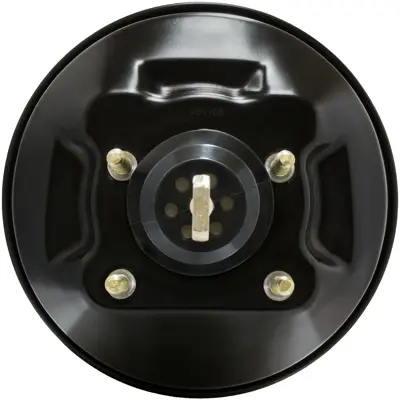 So I think I did what you said correctly. Here is a picture of a brake booster. I removed the hose from the top of the engine, which is connected to the black circle on the top left. I applied negative pressure/vacuum to the hose. I was to make sure that there are no leaks. When I applied vacuum, I heard no leaks and felt no leaks.
It's not just air in the system, because pedal does not come back up
If you have air in the brake system then when you apply the brakes all 4 wheels do not get correct pressure, so braking will seem less than it should and/or you will feel steering pull to the left or right
When you release the brake pedal it will come back up as it normally would.
A leaking brake system will cause the pedal to slowly go down to the floor as you continue to apply pressure to the pedal
Brake fluid is used because it doesn't compress very much under pressure
So, for example, when you apply 10 pounds of pressure on the brake pedal each wheel gets 10 pounds of pressure
If there is air in the system, the air will compress, so you would only get maybe 5 pounds of pressure at the wheel, or wheels, with air in its brake line
When you have the Master off move brake pedal to make sure it moves freely
If you have air in the brake system then when you apply the brakes all 4 wheels do not get correct pressure, so braking will seem less than it should and/or you will feel steering pull to the left or right
When you release the brake pedal it will come back up as it normally would.
A leaking brake system will cause the pedal to slowly go down to the floor as you continue to apply pressure to the pedal
Brake fluid is used because it doesn't compress very much under pressure
So, for example, when you apply 10 pounds of pressure on the brake pedal each wheel gets 10 pounds of pressure
If there is air in the system, the air will compress, so you would only get maybe 5 pounds of pressure at the wheel, or wheels, with air in its brake line
When you have the Master off move brake pedal to make sure it moves freely

Member
Joined: Apr 2017
Posts: 11
Likes: 0
From: So Jersey
It may not be a bad idea to check into basic mechanic courses offered in your area. Some Vo Tech centers or Community Colleges offer these courses. It's obvious that you have little experience in automotive repair. Or at the very least have someone more knowledgeable handy when you do try these repairs. Changing a master cylinder isn't that hard but its not changing a light bulb either.
Thread Starter
|
Member
Joined: Nov 2018
Posts: 7
Likes: 0
From: San Jose, CA
Sounds good. Thanks for your input and help. I have been thinking about taking a course but I just haven't found the time yet. As usual, I have a lot of projects going on. Do you guys prefer bench bleeding or mounting the master cylinder and bleeding it?

Member
Joined: Jun 2018
Posts: 2,362
Likes: 393
From: Everett, WA
Thread Starter
|
Member
Joined: Nov 2018
Posts: 7
Likes: 0
From: San Jose, CA
Thanks all for your help. I just changed it today. There might still be some air in the system....but it can't be that much. The brake pedal isn't sticky anymore, just feels slow to come up. It feels a little squishy. I went through pretty much a whole quart of brake fluid. I bled the master cylinder on the vehicle, only opening it up when the brake pedal was depressed. Then I bled each brake starting with the rear passenger side, rear driver side, passenger side, driver side. I bled it until it ran clear. I got paranoid that I didn't bleed the rear brakes enough so I went back and re-bled the rear brakes starting with passenger and then driver side. I didn't touch the front ones again. Seems like there's more pressure in the front brakes. When I bled them they shot out nearly shooting my eye out. The rear brakes just trickled out for the most part.
Member
Joined: Jun 2018
Posts: 2,362
Likes: 393
From: Everett, WA

Thread
Thread Starter
Forum
Replies
Last Post
FlyboyZR1
General Technical & Electrical
12
Oct 31, 2010 06:18 AM


