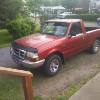
I'm helping an uncle of mine with his '99 Ranger, std wheelbase, 2.5L. Was running bad, classic signs of a fuel pump going bad (hard starts, having to cycle the key to get it to start, going dead at stops, etc) so we changed out the fuel pump- one of those you get from AutoZone, that you just get the motor and associated hardware, and you fix and splice it into the existing pump/sender assembly. Fired right up, he drove it home, next day, had to be towed back to my house because he only made it halfway to work.
So, we check the pressure (finally, apparently no gauge kit in town will read pressure off a Ford fuel rail Schrader valve, and that includes not being able to read it off my running Mercury Mystique) and, nothing. So, replace it at AZ under warranty, slap it in, pressure gauge rigged up on the engine side of the fuel filter (not a T, just, hose clamps) and we got a good 60 lbs just by cycling the pump a few times to prime it.
Put everything back together, bed back on, hop in it to go get pizza, and we ended up dragging it via my car and a tow strap, back to the house. Freaking got to where it didn't want to stay running, then died for good, after only a mile and a half at most- and again, just won't start, acts as if it's not getting gas. Haven't checked that pressure again yet, but I'm guessing it's got no pressure. Despite in both cases you could (and can) still hear the motor spin up when you turn the key.
What are we doing? Are AutoZone FP motors THAT lousy? Could we have a bad ground that's killing the motor, or the fuel pressure regulator on the fuel rail gone bad (gas is NOT present when you disconnect the vacuum hose, though I've not yet tried a vacuum pump on it)? What is that little thing that looks as if it's an over-pressure release inside the gas tank on the pump/sender assy? I blew air into where the fuel pump connects, and air did NOT exit out that plastic hose that appears to dump extra fuel back into the tank.
But something's going on. Replace the pump, fires right up, but the minute you go somewhere, there goes the fuel pressure. And it don't come back.
Thanks for any input, including telling me we've stupidly missed something very obvious, if that's the case.
Have you changed the fuel filter? The filter should be changed any time the fuel pump, or fuel pump assembly is replaced. The fuel filter is just behind the driver's door on the inside of the frame rail.
A clogged or dirty filter will kill a fuel pump.
I had to change my fuel pump back in March of '25. I bought the the full pump assembly. According to my local Ford Dealer the best one for a 98-2000 Ranger with the 2.5L and 112" wheel base is- Delphi Part Number HP10230 31421.
I haven't tried to wire in just a pump to the OEM pump assembly but my brother in law had a Ranger and tried 4 or 5 times and finally sold the truck. He should have just spent that money on a new assembly.
I bought mine on Amazon but it came open box and the fuel gauge sending unit doesn't work right, but since I got it in Dec of '24 and didn't install it until March last year I couldn't return it. It's still working, I just never know how much gas I have, and that sucks.
I would recommend getting the Delphi part number listed above and a Motorcraft fuel filter Part # FG-1071 which replaces the old FG-1002 in the Manual. Your best bet would probably be Rock Auto or NAPA.. Auto Zone and even Walmart have them but but I never used Oreilly's or Advance Auto so I'm not sure if they carry them.
I don't recommend Amazon for auto parts, I should have bought from somewhere else.
The Part Numbers again-
Fuel Filter- Motorcraft FG1071
Pump Assembly- Delphi HP10230- 31421
You might want to check the tank for dirt or soot and old funky smelling gas too. In fact the instruction sheet with the pump assembly warns that not draining and cleaning the tank voids any manufacturer warranty. I had already cleaned my tank a year or so before so I just scooped some gas out in a clean glass jar and let it sit for a couple hours and checked it for
water and dirt before installing the new assembly.
Dumb question but, you checked it for gas right? It wouldn't be the first time someone forgot. Hell, back in the 80's I pushed my 69 Triumph Bonneville 2 blocks before a friend pulled up on his bike, looked down and told me to turn the gas on. Yep, I hopped on after work, fired it up and took off
until the reserve ran out lol. I could have sworn I turned it on but didn't check, just figured I ran out of gas and started pushing. It happens.
I hope you get it figured out.
You're welcome.
Just remember when you're checking voltage at the pump with engine OFF key ON it only shows battery voltage for 3 seconds. It's for safety.
I'll post a few notes and pictures here regarding fuel pump troubleshooting. Fuel Pump Pin Chart
Here's a link to a short video explaining the test process. The vehicle is a GM but the principle is the same, just use the pin chart to find the right wires for the Ranger you're working on.
Unfortunately, you wasted your time. I wasted your time. All the time, a waste.
BUT.... on the plus side, being a forum mod elsewhither, I appreciate the usefulness in documenting things in threads, for those that come after.
So.
This is really stupid.
I think, earlier today, that pinout wouldn've been handy, because I wasn't getting any voltages that made sense at first. However, our troubleshooting was cut short.
Broken wire. It was a broken wire.
As an aside, I've always idly wondered what would happen in a gas tank, if a wire made bad contact. Apparently, nothing explosive.
So. What happened- a useful thing to remember, if you are NOT replacing the entire fuel pump assembly.
The cheaper kits that just come with the motor, and what's needed to switch that pump motor out, come with crimp wire connectors. Because they're not going to use the same plug, as whatever was in there before, so they come with a little wiring harness that you splice onto the assembly's harness. And the wire colors aren't going to be the same- have fun with that part.
The pump that we first removed, wasn't the original- and it itself was one that had been just the motor replacement. We just cut out the splices and made new ones. With the supplied crimp wire connectors. No crimp tool, just pliers, then tug at the wires to make sure they're securely crimped. If not, rinse and repeat.
So, crimped wiring, that we then made SURE was secure.
But that didn't keep the negative wire to the pump from breaking off inside the crimp connector. Even though we made SURE the wire wouldn't come out. I'll swear that on a stack of Bibles.
Still, be aware, wires can and do break.
Was the first replacement pump bad? Maybe. You could still hear it spool up, but no pressure. Maybe it wasn't getting enough current. Don't know.
The second one we put in, however- since it was the same brand, and we already had the plug connector wired in, we didn't re-splice, we just plugged the new one in.
Not knowing that there was a hidden break in the wiring. Because the wire was in the crimp connector, but it was just barely making contact, by then. We still didn't SEE it, we were looking to trace the wires to see which pins to test on the chassis harness, when the stupid thing come apart in my hand.
Got a new crimp connector, put a fresh stripped end on the wire, crimped it (again), and there you go. Fired right up.
Drove the heck out of it, no issues.
So, moral of the story, is, with these pump-only replacements, even when you think it's all back together right, and you've even tested the wires by hand, by tugging on them- those darn things can and will still break off inside the crimp. So, potential pitfall that will fool you, because you have no idea the wire broke. When exactly it broke, we don't know. Maybe when putting the warranty pump motor in. Not sure. But that's what happened, so, embarrassing, but duly recorded here for the next person who this happens to.
Thanks for the assist, and I'm still going to save those diagrams to disc, so that I can print them out and he can keep them in his glovebox, just in case we have to go through this crap again sometime. Thanks again. And, even though we both had to laugh at it, we really were relieved it turned out to be something so stupidly simple. Did not want to go chasing a bad ground or broken wire in the truck itself. Anyway, I'll mark this one as (solved). Appreciate the help!
I'll add, that I think all the times that I've personally put a fuel pump in, I think all the ones I've put in were the whole assembly. I don't care for this only the motor business. If you can afford the whole assembly, get the whole assembly. Rock Auto had a whole assembly for less than what this thing cost in the brick-and-mortar. But that wasn't my call.
Yea, I figured you already checked the wiring so I didn't mention it. Sorry about that.
Crimped connections on old wires can be problematic sometimes. I'm glad you got it running.
And good job helping your uncle with his truck. I actually ended up buying my 2000 Ranger off my Uncle after I got it running for him. I never planned on buying it, but after I got it running again he decided he couldn't handle the clutch anymore and asked me if I wanted it.
Well, my uncle and I happen to share the same age for half of every year. So it's not as if one of us is decrepit- we both are.
This one's an auto, but he'd probably enjoy a manual, I know I would. I miss my old C10 that had three on the tree and no power anything, got rid of it because my wife had a Silverado- which she then proceeded to take out in a blaze of glory. Now I make do with an Explorer, and a trailer I tow behind my little Mercury. Still be nice to have a truck, though.
My godchild's dad had a Ranger with the manual. I remember that clutch master cylinder went out, and I helped him drop the tranny and replace it. Was asking myself why do we need hydraulics for a clutch? But whatever, we managed to struggle through it. It was fun (no it wasn't).
My uncle is in his mid 80s, I'm close to 67. He had the truck for a long time but wasn't the original owner. He drove it 'til he couldn't, then sold it to me.
So you got rid of your C10, then your wife's Silverado got wrecked? I hope she wasn't hurt.
You might be thinking of the Slave cylinder on your Godchild's truck, which Ford decided slapping it around the pilot shaft inside the bell housing was a great idea. I guess having it on the outside of the trans just made too much sense.
I'm with you about the hydraulic clutch, I don't think I'll ever get fully used to mine. I'll take a mechanical clutch any day.
My Ranger also has manual windows and locks even though it's an XLT. There are a few things that don't match the XLT package or even the Vehicle ID sticker. I like to say it must have been close to 3pm on a Friday so they used whatever was close to finish it off and get out of there lol.
Who knows, maybe you'll find a truck that you and your wife both can agree on. I never planned on buying my Ranger, it just kind of happened. Even after spending most of my savings and working on it non stop for 4 years straight just to get it roadworthy, I wouldn't part with it now. They can really grow on ya.