


"Griggs Rig" -- really cheapo swaybar disconnects


Thread Starter
|
RF Veteran
Joined: Jun 2004
Posts: 10,623
Likes: 6
From: Kennett Square, PA

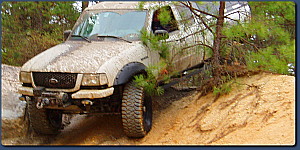
This is a crappy pic -- I should lighten it a bit for this purpose, but here it is for what it's worth.

Now, the drivers side wheel is at full "stuff" -- the bumpstop is hitting the lower a-arm. That's ALMOST impossible to do, even cocked on that hill with the swaybar connected. I needed to do that here to check for rubbing with the 35's and I found I couldn't get one side to stuff completely with the swaybar attached.
Look at the passengers side -- yes, it's about black but if you look you can see the outline of the passengers side tire tread and the upper curve of it. You can see it's way below where the drivers side is.
Fact is, there's not a LOT of flex in the front -- but getting what you can in terms of the difference between them helps when it can.
I'll lighten this a bit and repost it.
Now, the drivers side wheel is at full "stuff" -- the bumpstop is hitting the lower a-arm. That's ALMOST impossible to do, even cocked on that hill with the swaybar connected. I needed to do that here to check for rubbing with the 35's and I found I couldn't get one side to stuff completely with the swaybar attached.
Look at the passengers side -- yes, it's about black but if you look you can see the outline of the passengers side tire tread and the upper curve of it. You can see it's way below where the drivers side is.
Fact is, there's not a LOT of flex in the front -- but getting what you can in terms of the difference between them helps when it can.
I'll lighten this a bit and repost it.
Originally Posted by rolla_guy72
I'd just stick to what Griggs used. Looks like it would work well to me. Anyone have flex pics with the swaybars disconnected??


Last edited by V8 Level II; Oct 27, 2005 at 11:51 AM.
Thread Starter
|
RF Veteran
Joined: Jun 2004
Posts: 10,623
Likes: 6
From: Kennett Square, PA
Okay, I've definitely messed the picture up in general, but now you can see the flex.
Also, I made a better unit today that was drilled on the drill press here at work. That will distribute the force on the pin better than my hand-drilled at home one, which has a VERY sloppy hole drilled in it. On this one, I ground the threads off the screw on a bench grinder instead of drilling the nut out. My more precise hole leaves more metal in the bolt on either side of the hole which I am much more comfortable with.
Also, I made a better unit today that was drilled on the drill press here at work. That will distribute the force on the pin better than my hand-drilled at home one, which has a VERY sloppy hole drilled in it. On this one, I ground the threads off the screw on a bench grinder instead of drilling the nut out. My more precise hole leaves more metal in the bolt on either side of the hole which I am much more comfortable with.
Last edited by n3elz; Oct 27, 2005 at 11:53 AM.


Thread Starter
|
RF Veteran
Joined: Jun 2004
Posts: 10,623
Likes: 6
From: Kennett Square, PA
Yes, Colin, that's EXACTLY what I did, good call.
I don't have the orignal here at all, so I pulled the already MASSIVELY compressed one off the board here, ran it though GIMP, saved back with lots of compression, and downloaded to the board again. Not exactly what one want's to do to preserve quality, lol.
I don't have the orignal here at all, so I pulled the already MASSIVELY compressed one off the board here, ran it though GIMP, saved back with lots of compression, and downloaded to the board again. Not exactly what one want's to do to preserve quality, lol.

Member

Joined: Mar 2005
Posts: 288
Likes: 0
From: Cleveland, Ohio
Hey I have an idea but I'll have to go to my local Tractor Supply before confirming 100% Anyway I believe that you might be able to lynch pin the orginal bolt and effectively make a quick disconnect that is all stock parts. Anyway I got the idea after reading all this and thinking about how the deck mounts to my Cub Cadet. It uses two rather beefy lynch pins which appear to be grade 8 cuz they're that gold-ish color (that is grade 8 right?) anyway they have all sorts of parts and such to basically do what John has done cept without the drilling of the bolt or nut etc.
I'll go to TSC tomorrow (Thursday) and see what bits and pieces they have and report back. John what diameter, roughly speaking, is the end-link bolt? I'm guessing 5/8" -3/4" or so?
This is exciting making usable parts at home...GOOD WORK GRIGGS!!!
I'll go to TSC tomorrow (Thursday) and see what bits and pieces they have and report back. John what diameter, roughly speaking, is the end-link bolt? I'm guessing 5/8" -3/4" or so?
This is exciting making usable parts at home...GOOD WORK GRIGGS!!!
Originally Posted by SonicRanger001
I'll go to TSC tomorrow (Thursday) and see what bits and pieces they have and report back. John what diameter, roughly speaking, is the end-link bolt? I'm guessing 5/8" -3/4" or so?
Originally Posted by SonicRanger001
It uses two rather beefy lynch pins which appear to be grade 8 cuz they're that gold-ish color (that is grade 8 right?)
Thread Starter
|
RF Veteran
Joined: Jun 2004
Posts: 10,623
Likes: 6
From: Kennett Square, PA
Originally Posted by SonicRanger001
Hey I have an idea but I'll have to go to my local Tractor Supply before confirming 100% Anyway I believe that you might be able to lynch pin the orginal bolt and effectively make a quick disconnect that is all stock parts. Anyway I got the idea after reading all this and thinking about how the deck mounts to my Cub Cadet. It uses two rather beefy lynch pins which appear to be grade 8 cuz they're that gold-ish color (that is grade 8 right?) anyway they have all sorts of parts and such to basically do what John has done cept without the drilling of the bolt or nut etc.
I'll go to TSC tomorrow (Thursday) and see what bits and pieces they have and report back. John what diameter, roughly speaking, is the end-link bolt? I'm guessing 5/8" -3/4" or so?
This is exciting making usable parts at home...GOOD WORK GRIGGS!!!
I'll go to TSC tomorrow (Thursday) and see what bits and pieces they have and report back. John what diameter, roughly speaking, is the end-link bolt? I'm guessing 5/8" -3/4" or so?
This is exciting making usable parts at home...GOOD WORK GRIGGS!!!

By the way, I AM pinning the original bolt. I'm not sure what you were saying in the first paragraph, but the only thing "added" to mine is the lynch pin and the "hole", lol. The threads are removed on either the bolt or the nut. My original one I drilled out the nut, but on the most recent two I made I ground down the threads on the bolt instead.
Are you saying eliminate the nut and just pin the bolt? You have to peel the bolt/washer combo out of the insulator at the end, and put a different washer in, but it should work I would think. How do you pin the bolt without putting a hole in it I don't quite understand?

Member
Joined: May 2004
Posts: 3,048
Likes: 0
From: Fuquay Varina, NC
my questions is how to you maintain pressure on the bushings for the sway bar link? youd have to be pretty strong to squeeze it by hand so you dont risk running with a loose end link. im thinking of developing this idea to sell on my website, unless John or Bob wants to produce them for me 
Thread Starter
|
RF Veteran
Joined: Jun 2004
Posts: 10,623
Likes: 6
From: Kennett Square, PA
I don't worry about having lots of pressure on them. It doesn't seem to matter a whole lot on a normally driven vehicle. At least, I can't notice any difference.
You can get some pressure, however, you need someone to bounce the vehicle to make it happen. When you do that, you can ram home the pin when they press down.
Mine are too wierd to be a product, lol. Bob's are pretty slick, but he had some possible concerns and didn't want to show them until he was satisfied. I'm not describing them for that reason. I do really like what he did, is all I can say.
You can get some pressure, however, you need someone to bounce the vehicle to make it happen. When you do that, you can ram home the pin when they press down.
Mine are too wierd to be a product, lol. Bob's are pretty slick, but he had some possible concerns and didn't want to show them until he was satisfied. I'm not describing them for that reason. I do really like what he did, is all I can say.
Originally Posted by Gearhead61
Dangit Bob just tell us already!
My experiment allows the selection of an active or disabled front sway bar by tightening or loosening a set screw in each sway bar link. I drove my Ranger to Centralia with the sway bar active, disengaged it while there and locked it back in for the drive home. I really don't like the way the truck handles on pavement without a front sway bar. I also don't like how the sway bar makes the truck behave off road.
Here is a picture of the factory sway bar link (top) compared to mine:

A light spring and two collars replace the factory plastic spacer on each sway bar link bolt. For street use both set screws are tightened against small flats machined on the side of the bolt in the appropriate places. For off-road use, the sway bar function can be disabled by backing off the set screw on the upper collar.
The spring serves two purposes: (1) it holds the swaybar up so that it doesn't contact the tie rods or their accordion boots and (2) it pushes the upper collar into position to be retightened for street use.
This photo is the driver's side suspension with all 4 tires on level ground:

Here, the driver's side tire is much higher than the passenger side tire.

The small spring on the link has compressed, allowing the A-arm to move without significantly deflecting the sway bar. So, the sway bar does not affect the independent action of the front wheels while driving off road. The effect is the same as removing the bar.

RF Veteran

Joined: May 2005
Posts: 5,782
Likes: 2
From: College Station, TX
GOOD thinking! Did you make that yourself? or show the idea to someone and they made the pieces for you?
And I understand what you're saying about the bolt being in compression and tension, but why is that a problem? Bolts can handle compressional and tensional forces, can't they?
And I understand what you're saying about the bolt being in compression and tension, but why is that a problem? Bolts can handle compressional and tensional forces, can't they?
Originally Posted by Gearhead61
GOOD thinking! Did you make that yourself? or show the idea to someone and they made the pieces for you?
And I understand what you're saying about the bolt being in compression and tension, but why is that a problem? Bolts can handle compressional and tensional forces, can't they?
And I understand what you're saying about the bolt being in compression and tension, but why is that a problem? Bolts can handle compressional and tensional forces, can't they?

Member
Joined: Aug 2005
Posts: 1,836
Likes: 11
From: Lowell, AR
Hey guys. Someone from Ranger Power Sports linked me to this thread after I started a discussion about my idea for a REAR quick-disconnect. I know this completely changes the discussion, but it goes along with sway bar quick disconnects, and I’d love a second opinion.
I recently purchased a Bronco II rear sway bar to supplement my street driving. I love the new handling characteristics, but I can't stand the way it feels off road.
So here's my idea for a rear sway bar quick-disconnect. Kindof ghetto, but it's a preliminary idea for parts I will produce in Tungsten Carbide once I have a successful model to base it off of. I am a quality engineer with Kennametal Inc....a company that produces tungsten carbide products that are sold to vendors such as Shell Oil for their oil drilling process. We makes lots of "hard-core wear-resistant" parts, from Caterpillar Bulldozer front scoop teeth, to Circuit Board Drills for Dell. Tungsten Carbide is the hardest produced metal on earth, which is one level below diamond on the hardness scale. (Diamond is the hardest)
Rear Sway-Bar Quick Disconnect
Application: My 2000 Sport, 2.5L 2wd Auto. wannabe 4wd'er
Although I love the added traction and cornering abilities, I’m bothered by the fact of less articulation when off-road. I’ve been researching quick-disconnects (where you can easily disconnect one side of the sway bar end links) but can only find Jeep-specific products.
Since the bolt that attaches the end-link to the frame is easily accessible through the wheel-well, a trailer hitch pin, slightly altered, would (hopefully) do the trick.

Does anyone know the diameter of the bolt that holds the end link onto the frame?
There are two different sizes that I have found of pins:
Class I & II = 1/2"
Class III - IV = 5/8"
If anyone has one handy, would you mind you measure the length and diameter of this bolt?
I’m confident in the transverse rupture strength, but do you think the clip will be under any pressure or stress? I plan to weld a large washer on the "bent" end of the pin to prevent it from moving laterally.
Sorry, but not only do I NOT want to rely on the strength of two 1/8" pins, but I don't think anyone makes a set of these for Bronco II's, Rangers, or any other Ford with sway bars....especially a special-application Bronco II bar on a Ranger.

Is seems to me like the vertical movement of the sway bar end-links, especially over severe bumps, would sheer off those small pins. My idea uses the already-present strength of the hitch pin, and doesn't alter the strength of the end-link itself.
I recently purchased a Bronco II rear sway bar to supplement my street driving. I love the new handling characteristics, but I can't stand the way it feels off road.
So here's my idea for a rear sway bar quick-disconnect. Kindof ghetto, but it's a preliminary idea for parts I will produce in Tungsten Carbide once I have a successful model to base it off of. I am a quality engineer with Kennametal Inc....a company that produces tungsten carbide products that are sold to vendors such as Shell Oil for their oil drilling process. We makes lots of "hard-core wear-resistant" parts, from Caterpillar Bulldozer front scoop teeth, to Circuit Board Drills for Dell. Tungsten Carbide is the hardest produced metal on earth, which is one level below diamond on the hardness scale. (Diamond is the hardest)
Rear Sway-Bar Quick Disconnect
Application: My 2000 Sport, 2.5L 2wd Auto. wannabe 4wd'er
Although I love the added traction and cornering abilities, I’m bothered by the fact of less articulation when off-road. I’ve been researching quick-disconnects (where you can easily disconnect one side of the sway bar end links) but can only find Jeep-specific products.
Since the bolt that attaches the end-link to the frame is easily accessible through the wheel-well, a trailer hitch pin, slightly altered, would (hopefully) do the trick.
Does anyone know the diameter of the bolt that holds the end link onto the frame?
There are two different sizes that I have found of pins:
Class I & II = 1/2"
Class III - IV = 5/8"
If anyone has one handy, would you mind you measure the length and diameter of this bolt?
I’m confident in the transverse rupture strength, but do you think the clip will be under any pressure or stress? I plan to weld a large washer on the "bent" end of the pin to prevent it from moving laterally.
Sorry, but not only do I NOT want to rely on the strength of two 1/8" pins, but I don't think anyone makes a set of these for Bronco II's, Rangers, or any other Ford with sway bars....especially a special-application Bronco II bar on a Ranger.
Is seems to me like the vertical movement of the sway bar end-links, especially over severe bumps, would sheer off those small pins. My idea uses the already-present strength of the hitch pin, and doesn't alter the strength of the end-link itself.


RF Veteran
Joined: May 2005
Posts: 5,782
Likes: 2
From: College Station, TX
I don't see why you couldn't get away with using a hitch pin. I don't think the forces would be that great that they would shear the bolt off, or even bend it, with that rubber bushing of the swaybar. The bushing will absorb most of the compression I think.
Member
Joined: Aug 2005
Posts: 1,836
Likes: 11
From: Lowell, AR
Originally Posted by Gearhead61
I don't see why you couldn't get away with using a hitch pin. I don't think the forces would be that great that they would shear the bolt off, or even bend it, with that rubber bushing of the swaybar. The bushing will absorb most of the compression I think.
Great thinking! I never even thought of the rubber bushing absorbing the shock! I'm not so worried about it now, and I'm going to stop on the way home and pick up a hitch pin. I'll post pics of my final "test product" and results.
Originally Posted by rwenzing
Those are pictures of the rear sway bar on my truck - it is not a Bronco II rear bar. It's likely that the BII link arrangement is similar to what is pictured but i can't say for sure.


