


New lifting shackles installed and flex photos


Member

Joined: Jun 2004
Posts: 526
Likes: 0
From: Lexington, SC
The shackles are from 1988-1998, for clarification, due to Chevrolet's style changes.
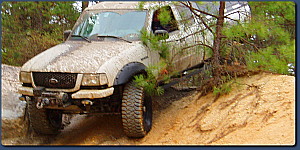
I'll add something about lift shackles. I don't know if anyone has experienced this problem, but it seemed like mine flattened the spring somewhat, and this led to increased spring wear during periods of serious offroading and also heavy load carrying. Now all I have are pretty messed up rear springs which I will replace with some real Skyjacker lift springs in a few months, so I can get rid of the OE block and extended shackle. I say lift shackles are good to attain small amounts of clearance, but shouldn't be used for long-term if they are going to see heavy use/abuse.
I'll add something about lift shackles. I don't know if anyone has experienced this problem, but it seemed like mine flattened the spring somewhat, and this led to increased spring wear during periods of serious offroading and also heavy load carrying. Now all I have are pretty messed up rear springs which I will replace with some real Skyjacker lift springs in a few months, so I can get rid of the OE block and extended shackle. I say lift shackles are good to attain small amounts of clearance, but shouldn't be used for long-term if they are going to see heavy use/abuse.
Thread Starter
|
RF Veteran
Joined: Jun 2004
Posts: 10,623
Likes: 6
From: Kennett Square, PA

Hmmm...well, my case is a little of both. I don't get as extreme because of being 2 wheel drive -- but on the other hand I often hit obstacles harder than the 4x4's because I need the momentum.
You're the second one to report this, if you read above, so I'll reallly be on the lookout for this.
Thanks everyone for the "head's up" and information. :)
You're the second one to report this, if you read above, so I'll reallly be on the lookout for this.
Thanks everyone for the "head's up" and information. :)
This is similar to the reports of torsion bar sag due to offroading after a torsion bar crank lift. In the case of either the torsion bar crank or the shackle lift, the spring must cope with more deformation at the bottom of travel than it had in its stock configuration. Any deformed spring will tend to relax over time and increasing the degree to which it is deformed will accelerate the process.

Member
Joined: May 2004
Posts: 3,048
Likes: 0
From: Fuquay Varina, NC
bob since i know the problem and you know the cause, what are your thoughts on my using longer shackles to lower my F150 (the shackle points the other way) do you think ill get flatter springs then too? in my case that wouldnt be so bad 
Originally Posted by SoundPer4mance
bob since i know the problem and you know the cause, what are your thoughts on my using longer shackles to lower my F150 (the shackle points the other way) do you think ill get flatter springs then too? in my case that wouldnt be so bad
Member
Joined: May 2004
Posts: 3,048
Likes: 0
From: Fuquay Varina, NC
Adding LED's to cruise control pods how-to
thanks bob im not too worries about travel down though, ive hauled a lot of stuff and it hasnt even come close to hitting the stops, but im going to try to get an air lift helper bag system to take some stress off the springs on heavy loads and to make sure i dont bottom out over bumps
im not too worries about travel down though, ive hauled a lot of stuff and it hasnt even come close to hitting the stops, but im going to try to get an air lift helper bag system to take some stress off the springs on heavy loads and to make sure i dont bottom out over bumps
Member
Joined: Jun 2004
Posts: 301
Likes: 0
From: Albuquerque, NM
Cool John, I was going to add a leaf, than do the shackles lift after I saw your first post but now I don't know. Did u measure b4 and after flex to see how much u gained? I know disconnecting the front sway bar will give u 1/2-1 inch more travel, (rear tire will be 1/2-1 inch in the air with the swaybar on, on ground with sway bar off)
Also u got any side shots of the truck on level ground. I want to see what it looks like with a 3 turn t-bar crank. And I know u have to have a picture of the drive tire stuffed!!
Also u got any side shots of the truck on level ground. I want to see what it looks like with a 3 turn t-bar crank. And I know u have to have a picture of the drive tire stuffed!!
Thread Starter
|
RF Veteran
Joined: Jun 2004
Posts: 10,623
Likes: 6
From: Kennett Square, PA
Originally Posted by SuperSonicFX4
Cool John, I was going to add a leaf, than do the shackles lift after I saw your first post but now I don't know. Did u measure b4 and after flex to see how much u gained? I know disconnecting the front sway bar will give u 1/2-1 inch more travel, (rear tire will be 1/2-1 inch in the air with the swaybar on, on ground with sway bar off)
Also u got any side shots of the truck on level ground. I want to see what it looks like with a 3 turn t-bar crank. And I know u have to have a picture of the drive tire stuffed!!
Also u got any side shots of the truck on level ground. I want to see what it looks like with a 3 turn t-bar crank. And I know u have to have a picture of the drive tire stuffed!!
I have a side shot I think. I'll put it up. The TOTAL t-bar crank is 7 turns. I did 4 turns prior to the shackle, and added 3 more after the shackle to level it.
I didn't measure it because I didn't care exactly how much I got, lol. I knew the shackle was going to give me "about an inch more", and that's all I was looking for with what I paid. Oh, if only ALL lifting cost about $50 per inch! (That's about what I paid with shipping for the shackles.)
I wanted to avoid the add-a-leaf because my rear is stiff enough already. The RSX shock valving is VERY stiff for a Ranger rear, though the fronts seem spot-on.
The stiff shock may be the salvation of my spring, though, since it serves to limit how fast (and subsequently how far) my spring moves in normal driving.
Member
Joined: Jun 2004
Posts: 301
Likes: 0
From: Albuquerque, NM
Originally Posted by n3elz
I didn't measure it because I didn't care exactly how much I got, lol. I knew the shackle was going to give me "about an inch more", and that's all I was looking for with what I paid. Oh, if only ALL lifting cost about $50 per inch! (That's about what I paid with shipping for the shackles.)
I wanted to avoid the add-a-leaf because my rear is stiff enough already. The RSX shock valving is VERY stiff for a Ranger rear, though the fronts seem spot-on.
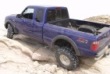
Tire in Air
Thread Starter
|
RF Veteran
Joined: Jun 2004
Posts: 10,623
Likes: 6
From: Kennett Square, PA
Well, with those tires, I'm not sure what you're getting!
The shackles should give more flex, theoretically, because the extra length can let the spring drop down further on the dropping side. On the other side, the spring must bend more to get the wheel stuffed.
I really got them to get BOTH lift and flex, for what they are both worth. Maybe it's not so much enhancement to my 2WD -- but it looks better and a little more clearance doesn't hurt.
I think the RSX may have more travel -- but they could just as well NOT. I got them before I even imagined getting the shackles. Your guess is as good as mine.
If I do the flex test again, I'll check the stuffed wheel to see if the stop is being hit or not. It was pretty well stuffed in there, though.
The shackles should give more flex, theoretically, because the extra length can let the spring drop down further on the dropping side. On the other side, the spring must bend more to get the wheel stuffed.
I really got them to get BOTH lift and flex, for what they are both worth. Maybe it's not so much enhancement to my 2WD -- but it looks better and a little more clearance doesn't hurt.
I think the RSX may have more travel -- but they could just as well NOT. I got them before I even imagined getting the shackles. Your guess is as good as mine.
If I do the flex test again, I'll check the stuffed wheel to see if the stop is being hit or not. It was pretty well stuffed in there, though.
Member
Joined: Jun 2004
Posts: 301
Likes: 0
From: Albuquerque, NM
If you hit your bump stop I will be impressed. I've had my wheels stuffed many a times and never once hit that bump stop. Just so u know, when u flex like that, left tire hanging, some times your driveshaft will rub on your gas tank. There should be a rubber thingy so it rubs on that instead of the tank. FYI
Don't know if you can see it in this picture.

Don't know if you can see it in this picture.
Thread Starter
|
RF Veteran
Joined: Jun 2004
Posts: 10,623
Likes: 6
From: Kennett Square, PA
Okay, I did a simplistic, but close enough calculation without having to resort to any trig.
Basically, to look at a simplified model: the spring is a lever that pivots on the front hanger through a small arc. When I put the new shackle on I moved the end of the spring (at the end of the radius from the pivot) down about 2" (2" longer shackle).
That distance is the "chord" of the arc, and not the length through the circumference of the circle, but it's close for such a small angle.
So the amount of angle change can be found from by taking the change in position and dividing it by cicumference of the circle the arc lies on, and then mulitplying that by 360 (the number of degrees in the circumferance. No messy trig.
The circumference of the circle the spring could theoretically swing through is the length of the spring times two times PI.
The Ranger springs are somewhere in the viciinity of 54" long.
54" * 2 * 3.14 = 339" (rounded off)
Dividing 2" by that: 2"/339" = 0.006 (rounded off)
Multiplying that time 360 degrees): 0.006 * 360 degrees = 2.2 degrees
So error introduced is around 2 degrees from the old stock shackles. I'll order some 2 degree shims.
I know it's not proper to round off so many times, and round off should be saved for the end -- however I did it the right way and it still came to "about" 2 degrees.
Basically, to look at a simplified model: the spring is a lever that pivots on the front hanger through a small arc. When I put the new shackle on I moved the end of the spring (at the end of the radius from the pivot) down about 2" (2" longer shackle).
That distance is the "chord" of the arc, and not the length through the circumference of the circle, but it's close for such a small angle.
So the amount of angle change can be found from by taking the change in position and dividing it by cicumference of the circle the arc lies on, and then mulitplying that by 360 (the number of degrees in the circumferance. No messy trig.
The circumference of the circle the spring could theoretically swing through is the length of the spring times two times PI.
The Ranger springs are somewhere in the viciinity of 54" long.
54" * 2 * 3.14 = 339" (rounded off)
Dividing 2" by that: 2"/339" = 0.006 (rounded off)
Multiplying that time 360 degrees): 0.006 * 360 degrees = 2.2 degrees
So error introduced is around 2 degrees from the old stock shackles. I'll order some 2 degree shims.
I know it's not proper to round off so many times, and round off should be saved for the end -- however I did it the right way and it still came to "about" 2 degrees.

Originally Posted by n3elz
Okay, I did a simplistic, but close enough calculation without having to resort to any trig.
Basically, to look at a simplified model: the spring is a lever that pivots on the front hanger through a small arc. When I put the new shackle on I moved the end of the spring (at the end of the radius from the pivot) down about 2" (2" longer shackle).
That distance is the "chord" of the arc, and not the length through the circumference of the circle, but it's close for such a small angle.
So the amount of angle change can be found from by taking the change in position and dividing it by cicumference of the circle the arc lies on, and then mulitplying that by 360 (the number of degrees in the circumferance. No messy trig.
The circumference of the circle the spring could theoretically swing through is the length of the spring times two times PI.
The Ranger springs are somewhere in the viciinity of 54" long.
54" * 2 * 3.14 = 339" (rounded off)
Dividing 2" by that: 2"/339" = 0.006 (rounded off)
Multiplying that time 360 degrees): 0.006 * 360 degrees = 2.2 degrees.
Basically, to look at a simplified model: the spring is a lever that pivots on the front hanger through a small arc. When I put the new shackle on I moved the end of the spring (at the end of the radius from the pivot) down about 2" (2" longer shackle).
That distance is the "chord" of the arc, and not the length through the circumference of the circle, but it's close for such a small angle.
So the amount of angle change can be found from by taking the change in position and dividing it by cicumference of the circle the arc lies on, and then mulitplying that by 360 (the number of degrees in the circumferance. No messy trig.
The circumference of the circle the spring could theoretically swing through is the length of the spring times two times PI.
The Ranger springs are somewhere in the viciinity of 54" long.
54" * 2 * 3.14 = 339" (rounded off)
Dividing 2" by that: 2"/339" = 0.006 (rounded off)
Multiplying that time 360 degrees): 0.006 * 360 degrees = 2.2 degrees.
 :
:2 * arc sin(1/54) = 2.12 degrees.
Thread Starter
|
RF Veteran
Joined: Jun 2004
Posts: 10,623
Likes: 6
From: Kennett Square, PA
I was in my truck when I did it the first time without a scientific calculator, lol! The only "messy" thing about trig is having the tables or a calculator which can do the arcsin lookup/calc.
For years, we've roughed in things in the field using a piece of paper and pencil and not tables when necessary, using things like I did. Sometimes "simple" math is all you have!
I've known guys who decided they couldn't do anything unless they had a scientific calc and/or tables. Not so! Sometimes you just have to think it through.
I will tell you I also would not have remembered WHICH trig calc to use to solve the problem. I would have looked that up as well! If you knew the correct way to do it "just out of your head" -- you're a better man than I! :)
For years, we've roughed in things in the field using a piece of paper and pencil and not tables when necessary, using things like I did. Sometimes "simple" math is all you have!
I've known guys who decided they couldn't do anything unless they had a scientific calc and/or tables. Not so! Sometimes you just have to think it through.
I will tell you I also would not have remembered WHICH trig calc to use to solve the problem. I would have looked that up as well! If you knew the correct way to do it "just out of your head" -- you're a better man than I! :)
Thread Starter
|
RF Veteran
Joined: Jun 2004
Posts: 10,623
Likes: 6
From: Kennett Square, PA
Originally Posted by 2K3TremorJon
whoa, im a little confused by this whole thing, I shouldve stayed in college. So how much cheaper are these "lifting shackles" then the usual Lift? And whats the difficulty level?
I paid $50 ($49 actually) shipped. It's pretty cheap.
Originally Posted by n3elz
I was in my truck when I did it the first time without a scientific calculator, lol! The only "messy" thing about trig is having the tables or a calculator which can do the arcsin lookup/calc.
For years, we've roughed in things in the field using a piece of paper and pencil and not tables when necessary, using things like I did. Sometimes "simple" math is all you have!
I've known guys who decided they couldn't do anything unless they had a scientific calc and/or tables. Not so! Sometimes you just have to think it through.
I will tell you I also would not have remembered WHICH trig calc to use to solve the problem. I would have looked that up as well! If you knew the correct way to do it "just out of your head" -- your a better man than I! :)
For years, we've roughed in things in the field using a piece of paper and pencil and not tables when necessary, using things like I did. Sometimes "simple" math is all you have!
I've known guys who decided they couldn't do anything unless they had a scientific calc and/or tables. Not so! Sometimes you just have to think it through.
I will tell you I also would not have remembered WHICH trig calc to use to solve the problem. I would have looked that up as well! If you knew the correct way to do it "just out of your head" -- your a better man than I! :)
Actually, I agree and regularly use approximations or do things graphically instead of mathematically - much to the chagrin of some book-learnt acquaintances. The calculation you did is obviously very good when used at small angles and I applaud your resourcefulness. :)
Thread Starter
|
RF Veteran
Joined: Jun 2004
Posts: 10,623
Likes: 6
From: Kennett Square, PA
I thought as much. I don't consider trig so messy and I do use it relatively regularly in my work -- however, it is possible that many of our members here might consider it so! :)
You? A smart-***? NO WAY!!!
You? A smart-***? NO WAY!!!


