


Factory fog light install?????

Member

Joined: Nov 2015
Posts: 1,635
Likes: 4
From: Evansville, Indiana

As long as you have a diagram and don't mix a bunch of colors together, wiring is every simple to do. If it helps, you can even use little sticky back tags and write on them what each wire does. People do this in IT frequently with numbered tags, and each number corrisponding to it's function.

Member
Joined: Apr 2016
Posts: 40
Likes: 0
From: Buckeye, AZ

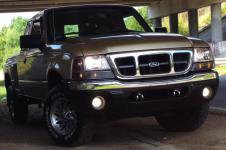
Well, I am 90% done. Didn't get much done last weekend as it was Mother's Day weekend, and had a bunch of Honeydoo's to accomplish. Did well today, , have the new bumper and valance installed, all that is left to do is wire in the lamp sockets, test and then install the lights. Had to stop cause this AZ sun is starting to get hot. I have before pictures, will after pictures. The hardest part of the whole install was getting the switch wire through the firewall and zip tying it out of the way. Again, many thanks, your insight to this made it easier than it seemed.
 And the finished

Member
Joined: Nov 2015
Posts: 1,635
Likes: 4
From: Evansville, Indiana
I'm not sure about the square fog lights, but on the round fog lights there was a large bolt that you turned to raise or lower the beam. Although I found the adjustment on those round ones didn't do hardly anything.
Since each design is wildly different from another, I can't really say what to look for in particular. However, give them a try at night and see where the beam lies. It's possible you don't have to adjust them at all.
Here's a vid about how to adjust lighting in general, and that should help somewhat.
Since each design is wildly different from another, I can't really say what to look for in particular. However, give them a try at night and see where the beam lies. It's possible you don't have to adjust them at all.
Here's a vid about how to adjust lighting in general, and that should help somewhat.
Member
Joined: Apr 2016
Posts: 40
Likes: 0
From: Buckeye, AZ
Fog lamps adjusted (had problems on Sunday,do not know why) all is good now, passenger side is no longer pointing to the ground. Again, my thanks. You made what seemed to be a daunting task into a simple project.

Member
Joined: May 2016
Posts: 4
Likes: 0
From: California
[First Post!!!]
Hey there, I have been reading this thread, and you have been *extremely* helpful!
I would also like to wire fog lights on my 2000 3.0 XLT
My issue is that, while I have the harness under the hood, I cannot find the switch in the cab to plug in to! I purchased the relay I need, but I'm not sure where to go from there.
So: will the main fuse box be completely wired?
Will I need to find a way to wire a plug into the main fuse box?
Am I just not finding the switch wire in the cab?
Is the switch wiring partially wired, and do/can I track it down and use it?
Thanks so much, I'd really love to use the OEM harness!!
Member
Joined: Nov 2015
Posts: 1,635
Likes: 4
From: Evansville, Indiana
If you are partially wired, you *can* trace it out and find out where it ended, but it is a complete PITA to do that and isn't worth it at all. You'll likely cause more problems for yourself by cutting up the harnesses to find out where one set of wires ended. If you're partially wired, run your own harness.
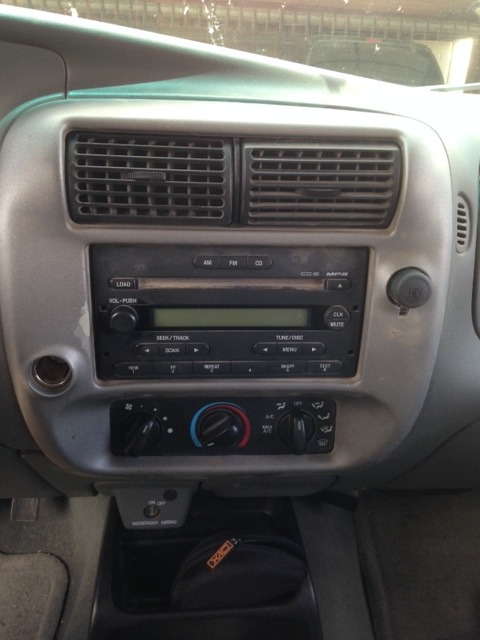
If you didn't have fog lights installed factory, you won't have the switch installed in the cab, anywhere. You'll need the switch if you plan to use the OEM harness, which can be found at a salvage yard off other rangers or explorers. With that you will also need a new radio bezel which has a cut out for the fog light switch, as well as this plastic 'bracket' that the fog light switch clips into, and the bracket itself screws into the bezel with (I think) two our four phillips screws.
If you are prewired from end to end, you will have two plugs under the bumper, one for each side right next to where the abs harness plugs into. It will be a four pin round connector, although only two pins are utilized within the connector.
You will also have a four pin connector behind the radio bezel connected to nothing. It's usually yellow with a translucent plastic. It's a 'flat four' connector, so it would be laid out like this. pin---pin---pin---pin. This is what the fog light switch connects to in order to turn the fog lights on. If you have those two things then you're good to go. All you need is to install a proper rated fuse (if not already installed) in the appropriate slot as well as one or two relays. For my 1999 Ranger I need two relays and one fuse. All that information on relays and fuses can be found in your owners manual for your specific year.
To answer "Will I need to find a way to wire a plug into the main fuse box?" The answer is no, if you have a complete harness. If you don't, it is possible to use an 'add-a-circuit' to power your aftermarket fog lights, but honestly I wouldn't recommend it for something like that. You're much better off using an inline fuse coming directly off the positive battery terminal.
In general, Add-a-circuit is usually reserved for loads of 15 amps or less, according to the product packaging, but I personally wouldn't trust it for loads higher than 10, if for nothing more than having a nice 5 amp safety margin.
"Will the main fuse box be completely wired?" As far as I'm aware, the fuse box will always be wired "fully". I say that in quotes because there will sometimes be unused slots in the box itself, like mine for example. However yours may be different and there are no unused slots. A quick and dirty way to tell if the slot you're looking at is occupied with the necessary wires and connectors for, say a relay for example, is to try and connect a relay to said socket. If it 'falls' in with no resistance, then it's unused. If it actually pushes in, then there's pins there.
Hopefully that helps. Good luck!
If you didn't have fog lights installed factory, you won't have the switch installed in the cab, anywhere. You'll need the switch if you plan to use the OEM harness, which can be found at a salvage yard off other rangers or explorers. With that you will also need a new radio bezel which has a cut out for the fog light switch, as well as this plastic 'bracket' that the fog light switch clips into, and the bracket itself screws into the bezel with (I think) two our four phillips screws.
If you are prewired from end to end, you will have two plugs under the bumper, one for each side right next to where the abs harness plugs into. It will be a four pin round connector, although only two pins are utilized within the connector.
You will also have a four pin connector behind the radio bezel connected to nothing. It's usually yellow with a translucent plastic. It's a 'flat four' connector, so it would be laid out like this. pin---pin---pin---pin. This is what the fog light switch connects to in order to turn the fog lights on. If you have those two things then you're good to go. All you need is to install a proper rated fuse (if not already installed) in the appropriate slot as well as one or two relays. For my 1999 Ranger I need two relays and one fuse. All that information on relays and fuses can be found in your owners manual for your specific year.
To answer "Will I need to find a way to wire a plug into the main fuse box?" The answer is no, if you have a complete harness. If you don't, it is possible to use an 'add-a-circuit' to power your aftermarket fog lights, but honestly I wouldn't recommend it for something like that. You're much better off using an inline fuse coming directly off the positive battery terminal.
In general, Add-a-circuit is usually reserved for loads of 15 amps or less, according to the product packaging, but I personally wouldn't trust it for loads higher than 10, if for nothing more than having a nice 5 amp safety margin.
"Will the main fuse box be completely wired?" As far as I'm aware, the fuse box will always be wired "fully". I say that in quotes because there will sometimes be unused slots in the box itself, like mine for example. However yours may be different and there are no unused slots. A quick and dirty way to tell if the slot you're looking at is occupied with the necessary wires and connectors for, say a relay for example, is to try and connect a relay to said socket. If it 'falls' in with no resistance, then it's unused. If it actually pushes in, then there's pins there.
Hopefully that helps. Good luck!
Member
Joined: May 2016
Posts: 4
Likes: 0
From: California
If you are partially wired, you *can* trace it out and find out where it ended, but it is a complete PITA to do that and isn't worth it at all.
If you are prewired from end to end, you will have two plugs under the bumper, one for each side right next to where the abs harness plugs into. It will be a four pin round connector, although only two pins are utilized within the connector.
You will also have a four pin connector behind the radio bezel connected to nothing. It's usually yellow with a translucent plastic. It's a 'flat four' connector, so it would be laid out like this. pin---pin---pin---pin. This is what the fog light switch connects to in order to turn the fog lights on. If you have those two things then you're good to go. All you need is to install a proper rated fuse (if not already installed) in the appropriate slot as well as one or two relays. For my 1999 Ranger I need two relays and one fuse. All that information on relays and fuses can be found in your owners manual for your specific year.
To answer "Will I need to find a way to wire a plug into the main fuse box?" The answer is no, if you have a complete harness. If you don't, it is possible to use an 'add-a-circuit' to power your aftermarket fog lights, but honestly I wouldn't recommend it for something like that. You're much better off using an inline fuse coming directly off the positive battery terminal.
In general, Add-a-circuit is usually reserved for loads of 15 amps or less, according to the product packaging, but I personally wouldn't trust it for loads higher than 10, if for nothing more than having a nice 5 amp safety margin.
"Will the main fuse box be completely wired?" As far as I'm aware, the fuse box will always be wired "fully". I say that in quotes because there will sometimes be unused slots in the box itself, like mine for example. However yours may be different and there are no unused slots. A quick and dirty way to tell if the slot you're looking at is occupied with the necessary wires and connectors for, say a relay for example, is to try and connect a relay to said socket. If it 'falls' in with no resistance, then it's unused. If it actually pushes in, then there's pins there.
Hopefully that helps. Good luck!
If you are prewired from end to end, you will have two plugs under the bumper, one for each side right next to where the abs harness plugs into. It will be a four pin round connector, although only two pins are utilized within the connector.
You will also have a four pin connector behind the radio bezel connected to nothing. It's usually yellow with a translucent plastic. It's a 'flat four' connector, so it would be laid out like this. pin---pin---pin---pin. This is what the fog light switch connects to in order to turn the fog lights on. If you have those two things then you're good to go. All you need is to install a proper rated fuse (if not already installed) in the appropriate slot as well as one or two relays. For my 1999 Ranger I need two relays and one fuse. All that information on relays and fuses can be found in your owners manual for your specific year.
To answer "Will I need to find a way to wire a plug into the main fuse box?" The answer is no, if you have a complete harness. If you don't, it is possible to use an 'add-a-circuit' to power your aftermarket fog lights, but honestly I wouldn't recommend it for something like that. You're much better off using an inline fuse coming directly off the positive battery terminal.
In general, Add-a-circuit is usually reserved for loads of 15 amps or less, according to the product packaging, but I personally wouldn't trust it for loads higher than 10, if for nothing more than having a nice 5 amp safety margin.
"Will the main fuse box be completely wired?" As far as I'm aware, the fuse box will always be wired "fully". I say that in quotes because there will sometimes be unused slots in the box itself, like mine for example. However yours may be different and there are no unused slots. A quick and dirty way to tell if the slot you're looking at is occupied with the necessary wires and connectors for, say a relay for example, is to try and connect a relay to said socket. If it 'falls' in with no resistance, then it's unused. If it actually pushes in, then there's pins there.
Hopefully that helps. Good luck!
I am aware of what the switch it looks like, but what color are the wires?
also, would those wires be coming from the 'hood' fuse box, or the 'door' fuse box? That would probably help me track them down!
Also, if you have any idea to describe where the swich wire might be run, I'd be very grateful!
Thanks for your help, I'm learning a lot!
Member
Joined: May 2016
Posts: 4
Likes: 0
From: California
Another question - if I am not wired in the cab, wouldn't I basically just need to wire a switch to the relay in the 'hood' fuse box? If I could find the little clip thing it goes into, it wouldn't be too hard.. Would it? I already have that fusebox open
Member
Joined: Nov 2015
Posts: 1,635
Likes: 4
From: Evansville, Indiana
Regardless of which fuse box they're run from, You'll lose the wires behind the tape and such, as well as behind every panel. That dash harness is probably 1.5 inches thick with wires, tape, and plastic loom. I know one wire off the top of my head is light blue with a black tracer, and I believe another wire going to it is light blue with a red tracer. I want to say one wire is black and another purple, but I'm not for certain on that. It also changes year to year in some cases, so I can't give a definitive set of colors to look for. Usually the plug is just laying there of to the side, somewhere around the HVAC (AKA climate control panel). It's possible it's tucked into that metal plate on the right side of the radio bezel hole. It's likely going to be on the right side, just laying there dormant. Of course, if it's not there then it's not there. Which leads me to....
....Yeah you *can* just solder wires to the fuse box, however in doing so, you introduce a failure point (two or three) as a result of adding wires into the harness, splicing into existing wires. Reason being is, no matter what you do, moisture will ALWAYS get to your connections and as a result will corrode the connections over time, especially considering that under the hood is subjected to several heat cycles as well as general rain salt and debris. Granted, a minimal amount of all three, but still there.
At the same time, you'll inadvertenly send power to the other end of those wires, and without knowing where they're going then you're liable to cause another problem. That problem could be anything to a quick fuse-blowing short circuit to a vehicle engulfing fire. They could have ended those wires with a plug or they could have just simply cut them at a given point. I honestly don't know what they do, but in half-prewiring situations, it's always best to just leave the factory harness alone and run your own. It may sound daunting, but it's one of the simplest things you can do to a vehicle. The hard part is connecting them, and even that is pretty simple if you have a diagram to follow.
....Yeah you *can* just solder wires to the fuse box, however in doing so, you introduce a failure point (two or three) as a result of adding wires into the harness, splicing into existing wires. Reason being is, no matter what you do, moisture will ALWAYS get to your connections and as a result will corrode the connections over time, especially considering that under the hood is subjected to several heat cycles as well as general rain salt and debris. Granted, a minimal amount of all three, but still there.
At the same time, you'll inadvertenly send power to the other end of those wires, and without knowing where they're going then you're liable to cause another problem. That problem could be anything to a quick fuse-blowing short circuit to a vehicle engulfing fire. They could have ended those wires with a plug or they could have just simply cut them at a given point. I honestly don't know what they do, but in half-prewiring situations, it's always best to just leave the factory harness alone and run your own. It may sound daunting, but it's one of the simplest things you can do to a vehicle. The hard part is connecting them, and even that is pretty simple if you have a diagram to follow.
Member
Joined: May 2016
Posts: 4
Likes: 0
From: California
I know one wire off the top of my head is light blue with a black tracer, and I believe another wire going to it is light blue with a red tracer. I want to say one wire is black and another purple, but I'm not for certain on that. It also changes year to year in some cases, so I can't give a definitive set of colors to look for. Usually the plug is just laying there of to the side, somewhere around the HVAC (AKA climate control panel). It's possible it's tucked into that metal plate on the right side of the radio bezel hole. It's likely going to be on the right side, just laying there dormant. Of course, if it's not there then it's not there. Which leads me to....
It may sound daunting, but it's one of the simplest things you can do to a vehicle. The hard part is connecting them, and even that is pretty simple if you have a diagram to follow.
It may sound daunting, but it's one of the simplest things you can do to a vehicle. The hard part is connecting them, and even that is pretty simple if you have a diagram to follow.
Thanks again, I really appreciate all the help!
Member
Joined: Apr 2016
Posts: 40
Likes: 0
From: Buckeye, AZ
Fixgeer, the plug for the fog light should be on the right hand side of the radio bezel, sitting in a slot for it. I was told all Rangers were pre-wired, all I had was the plug under the bezel. With the great help of TheArcticWolf1911, this wrench turner (who is also electrically disabled) was able to do a complete wiring job in no time at all. My only delays were of my fault, by not realizing that not all assemblies were complete assemblies.

Thread
Thread Starter
Forum
Replies
Last Post
Want to Buy: 93 factory fog light switch
rpwillix
OLD - Interior, Exterior, Electrical, & Misc.
0
Nov 8, 2010 06:46 PM
SVT01RANGER
OLD - Interior, Exterior, Electrical, & Misc.
0
May 28, 2010 05:24 PM
SVT01RANGER
OLD - Interior, Exterior, Electrical, & Misc.
9
Apr 3, 2010 12:06 AM
Ranger_Envy
General Technical & Electrical
3
Jul 27, 2009 09:05 PM


